Inspired by the NCX Group podcast episode EP 6 – The DoD, and NIST 800-171.
The Temecula Valley has more defense-connected businesses than most people realize. There are machine shops in Murrieta, electronics assemblers along the I-15, engineering consultants in Temecula, and small manufacturers in Menifee and Lake Elsinore that build parts for companies that sell to the Department of Defense. If any of that describes you, there’s a document that should be on your radar: NIST 800-171. It decides how you must protect sensitive government information, and more and more often it decides whether you can keep winning defense work at all.
NCX Group was talking about this standard back in 2017, long before most small suppliers had heard of it. The advice from that conversation still holds: don’t treat it as a federal headache to put off. Treat it as a practical security blueprint, and start early. Here’s what it means for a small business in 2026, in plain English.
NIST Special Publication 800-171 is a set of security requirements for protecting Controlled Unclassified Information (CUI) when it sits on systems outside the federal government. That means your laptops, your file server, your email, and your cloud storage. CUI isn’t classified, but the government still wants it guarded. Think engineering drawings, technical specifications, test reports, export-controlled data, and some contract details.
Revision 2, the version defense contracts currently point to, contains 110 security requirements grouped into 14 families. They include access control, awareness training, audit logging, configuration management, identification and authentication, incident response, maintenance, media protection, personnel security, physical protection, risk assessment, security assessment, system and communications protection, and system and information integrity. Under the defense contract clause DFARS 252.204-7012, contractors and subcontractors that handle this kind of information are expected to put those controls in place.
For years, many contractors simply said they met NIST 800-171, and nobody checked closely. The Cybersecurity Maturity Model Certification (CMMC) program was built to close that gap by tying verified security levels to contract awards. Phase 1 began in November 2025. It requires annual Level 1 self-assessments for companies that handle basic Federal Contract Information, and Level 2 self-assessments against the 110 NIST 800-171 controls for companies handling CUI. Results get posted in the government’s Supplier Performance Risk System (SPRS).
Phase 2 was supposed to start on November 10, 2026, and would have required outside third-party assessments for many Level 2 contractors. In July 2026, the Department of Defense suspended Phase 2 to review the program and reduce the burden on small and mid-sized suppliers. Some owners heard “suspended” and assumed they were off the hook. They aren’t. Phase 1 self-assessment requirements are still in force, the DFARS safeguarding clause still applies, and prime contractors are still flowing these requirements down to their subcontractors. A self-assessment you sign is a statement to the federal government, so claiming compliance you don’t actually have carries real legal and financial risk.
Attackers like small suppliers because they’re the easy way into bigger targets. A 12-person machine shop holding a prime contractor’s drawings is often far easier to break into than the prime itself. That makes NIST 800-171 more than paperwork. It’s a defense against the same threats we deal with every week: phishing emails that steal passwords, ransomware that locks up a production schedule, and old, unpatched computers that let attackers walk right in.
There’s a business angle, too. Primes are trimming their supplier lists to vendors who can show their security status. If a competitor down the road has a solid SPRS score and you don’t, that can quietly decide who gets the next purchase order.
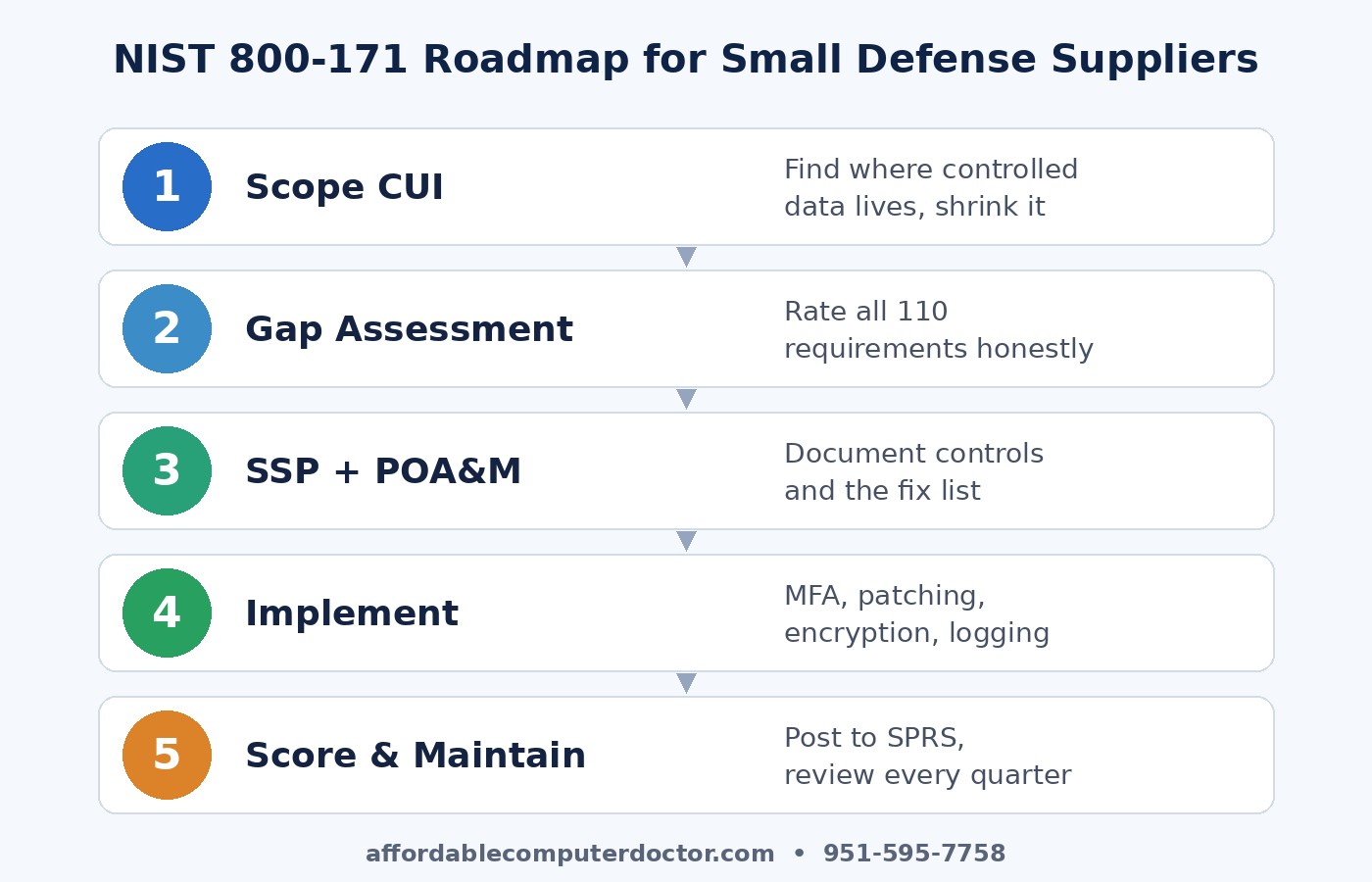
Before you buy anything, figure out where controlled information actually lives. Which inboxes receive drawings? Which shared folders hold specs? Which shop-floor PCs open CAD files? The smartest money you’ll spend is on reducing scope. Keep CUI in one well-protected place, like a dedicated, compliant cloud environment or a separate network segment, so the other 90% of your business doesn’t have to meet every control.
Go through all 110 requirements and mark each one met, partially met, or not met. Be blunt with yourself. This is your starting point, and it feeds the scoring method the DoD uses for SPRS submissions. Most small businesses discover they already do more than they thought, plus a handful of big gaps.
A System Security Plan (SSP) describes your environment and how each control is handled. A Plan of Action and Milestones (POA&M) lists what’s still missing, who owns it, and when it’ll be fixed. Without an SSP, you can’t credibly claim compliance, so this document matters as much as any firewall.
Some controls carry more weight in scoring and stop more attacks than others. In our experience, these are the ones to tackle first:
Once your controls and documents are in place, calculate your score, post it in SPRS, and make sure a senior official is comfortable affirming it. Then put recurring reviews on the calendar. Compliance slips as soon as a new hire gets added without MFA or a laptop misses three months of updates. Treat it like equipment maintenance on the shop floor: small, regular checkups beat emergency repairs.
You don’t need a DoD contract to benefit from NIST 800-171. A dental office in Wildomar, a real estate team in Temecula, or a family managing finances from home can use the same ideas: know where your sensitive data lives, limit who can reach it, turn on MFA, encrypt your devices, keep everything updated, and back it up. The framework is basically a checklist of good security habits, written by people who study what attackers do.
NIST 800-171 can look overwhelming on paper, but small businesses handle it best one step at a time, beginning with the controls that actually stop attacks. A. Computer Doctor helps businesses across Murrieta, Temecula, Menifee, Wildomar, and Lake Elsinore set up MFA, encryption, patching, secure backups, and the IT basics these frameworks are built on. If you’d like a second set of eyes on your setup, call us at 951-595-7758 or reach out online. We’ll talk it through in plain English.
Source and credit: this article was inspired by the NCX Group Bite Size Security podcast episode “EP 6 – The DoD, and NIST 800-171.” The 2026 CMMC status reflects the Department of Defense’s July 2026 Phase 2 suspension. Always confirm requirements against your specific contract.
